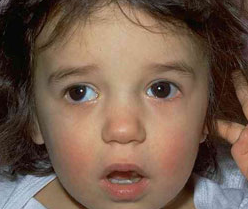
When looking at an object, a normal person has both eyes pointed straight at that object. If only one eye is looking straight and the other eye is turned away, then that person has a squint.
The medical name for squint is strabismus. It is a condition where the eyes do not look in the same direction. Whilst one eye looks forwards to focus on an object, the other eye turns either inwards, outwards, upwards or downwards.Squints are common in children.Many adults also have squints.
Squints are common and affect about 1 in 20 children. You might even spot that your baby has a squint. Most squints develop before preschool age, usually by the time a child is 3 years old. Sometimes squints develop in older children, or in adults.
A squint develops when the eye muscles do not work together in a balanced way, so that the eyes do not move together correctly.

What are the different types of Squint ( Strabismus ) ?
Squints can be divided into different categories :
- By the direction of the squinting (turning) eye:
- An eye that turns inwards is called an esotropia.
- An eye that turns outwards is called an exotropia.
- An eye that turns upwards is called a hypertropia.
- An eye that turns downwards is called a hypotropia.
- Whether the squint is present all the time (constant), or comes and goes (intermittent).
- Whether the affected eye turns when the eyes are open and being used (manifest squint) or whether the eye turns only when it is covered or shut (latent squint) but looks fine when the eyes are open.
- Whether the severity (angle or deviation of the eye) of the squint is the same in all directions or not:
- A concomitant squint means that the angle (degree) of the squint is always the same in every direction that you look. That is, the two eyes move well, all the muscles are working but the two eyes are always out of alignment by the same amount, no matter which way you look.
- An incomitant squint means that the angle of squint can vary. For example, when you look to the left, there may be no squint and the eyes are aligned. However, when you look to the right, one eye may not move as far and the eyes are then not aligned.
By age of onset-childhood or adult squint: Most squints develop at some time in the first three years of life. Some develop in older children and adults. Squints that develop
in children usually have different causes to those that develop in adults.
The causes of squint are not always known, but some children are more likely to develop it than others. Among the possible causes are:
Congenital squint :
Sometimes a baby is born with a squint, although it may not be obvious for a few weeks. In about half of such cases, there is a family history of squint or the need for glasses. The eye muscles are usually at fault. If squint is suspected, it is important that the baby be referred for accurate assessment at the earliest opportunity. Sometimes a baby has what is known as ‘pseudo squint’ which is related to the shape of the face, but a baby with a true squint will not grow out of it.Early eyecheck up is the key to early diagnosis and cure to this as its imperative the child grows up with good vision.
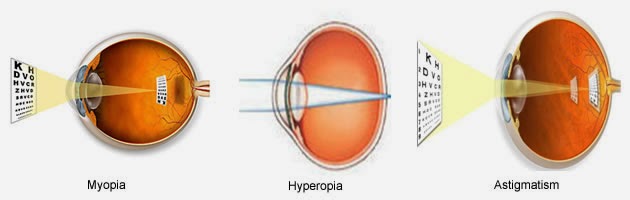
Long sight ( hypermetropia-The eye sees far off objects but cannot see close objects ) :
Long sightedness can sometimes lead to a squint developing as the eyes ‘over-focus’ in order to see clearly. In an attempt to avoid double vision, the brain may automatically respond by ‘switching off’ the image from one eye and turning the eye to avoid using it. If left untreated, a ‘lazy eye’ (amblyopia) may result. The most common age for this type of squint to start is between 10 months and two years, but it can occur up to the age of five years. It is usually first noticed when a baby is looking at a toy, or at a later age when a child is concentrating on close work, such as a jigsaw or reading.
Childhood illnesses :
Squint may develop following an illness such as measles or chickenpox. This may mean that a tendency to squint has been present but, prior to the illness, the child was able to keep his or her eye straight.
Nerve damage:
In some cases a difficult delivery of a baby where forceps are used to assist in the delivery or illness damaging a nerve can lead to a squint.

What are the treatments for Squint ( Strabismus ) ?
Treating 'lazy' eye (amblyopia):
The main treatment for amblyopia is to restrict the use of the good eye. This then forces the affected eye to work. If this is done early enough in childhood, the vision will usually improve, often up to a normal level. In effect, the visual development of the affected eye catches up. The common way this is done is to put a patch over the good eye. This is called eye patching.
The length of treatment with an eye patch is dependent on the age of the child and the severity of the amblyopia. The patch may be worn for a few hours a week or for most of the day, every day. Treatment is continued until either the vision is normal or until no further improvement is found. It may take from several weeks to several months for eye patching to be successful.
Your child will be followed up, usually until about 8 years of age, to make sure that the treated eye is still being used properly and does not become amblyopic again. Sometimes, further patch treatment (maintenance treatment) is needed before the vision pathways in the brain are fixed and cannot be changed.
Occasionally, eye drops to blur the vision in the good eye, or glasses that prevent the good eye from seeing clearly, are used instead of an eye patch.
Vision therapy can be used as a treatment to maintain the good work achieved by eye patching. This involves playing visually demanding games with a child to work the affected eye even harder - like eye training.
Note: eye patching and other treatments for amblyopia aim to improve vision; they do not by themselves correct the appearance of a squint.
Correcting refractive errors
If a child has a refractive error (long or short sight, for example) then glasses will be prescribed. This corrects vision in the eye. It may also straighten the squinting eye, if the refractive error was the cause of the squint.
Botulinum toxin
Botulinum toxin (also know as Botox®) stops muscles from working (it paralyses them). It is used for a variety of conditions where it is helpful to weaken one or more muscles. In recent years, injections of botulinum toxin directly into eye muscles have been used as a treatment for certain types of squint, particularly for squints that turn inward (esotropia). This treatment is an alternative to surgery - but only for certain types of squint.
Surgery
In many cases an operation is advised to make the eyes as straight as possible. The main aim of surgery is to improve the appearance of the eyes. In some cases, surgery may also improve or restore binocular vision (this means that the two eyes are working together).Squint surgery is done on the muscles that move the eyeball.
The exact operation that is done depends on the type and severity of the squint. It may involve moving the place where a muscle attaches to the eyeball or, one of the muscles that moves an eye may be strengthened or weakened depending on the requirement to correct the squint.Sometimes a combination of these techniques is used.
Squint (strabismus) surgery usually greatly improves the straightness of the eyes. Sometimes, even after an operation, the eyes are not perfectly straight. In some cases, two or more operations are needed to correct the squint. Sometimes a special stitch is put in place which can be adjusted later on if further correction is needed.
It is possible that several years after successful surgery, the squint may gradually return again. A further operation is an option to restraighten the eyes.
Vision Therapy for Strabismus
This is the new non invasive method of treating squints,very often squint surgery mighr need to be combined with vision therapy to give good sustainable results.
Strabismus occurs when the brain processes spatial information from the two eyes differently. When the brain can’t combine the two images into a single 3D image, double vision will occur. This results in confusion and difficulty performing many tasks in daily life.
To solve this confusion, the brain needs to learn to suppress (ignore) one of the images or figure out how to get one of the images out of the way. The second image can get out of the way if the eye turns in, out, up or down, or some combination.
Treatment involves getting the brain to pay attention to the strabismic eye information while the other eye is open and able to see. In most cases, there is one eye that turns more frequently. Emphasizing peripheral visual processing of spatial information helps to maintain focusing with two eyes together.
Once these skills are in place, then it’s a matter of practicing using both eyes together at different distances and doing different activities. Eventually, this will allow for comfortable and efficient use of both eyes at the same time.
The success of vision therapy for strabismus depends on the direction, magnitude and frequency of the eye turn. Vision therapy has been proven effective for treating an intermittent form of strabismus called convergence insufficiency and Small degree of deviation.
Contact us by sending a mail or through our site..

Our mail id : krishnaeyecenter@gmail.com
Website : www.krishnaeyecentre.com


_PHIL_4284_lores.jpg)


