- Lazy Eye or Amblyopia
- Watering – Blocked Tear Ducts
- Retinopathy of Prematurity (ROP)
When
light rays from a distant object do not come to a focus on the
retina, the image of the object appears blurred and the condition is
called Ametropis.
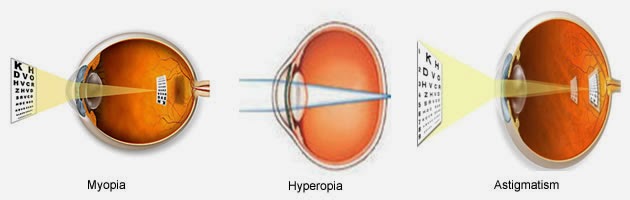
When
the size of the eyeball is longer than normal, these light rays are
focused in front of the retina. This is Myopia or short sightedness. This can be corrected by concave lenses as
spectacles or contact lenses.
When
the size of the eyeball is shorter than normal, these light rays are
focused behind the retina. This is Hypermetropia or long sightedness. This can be corrected by convex lenses as spectacles
or contact lenses.
A
normal eye has spherical cornea in all its meridians. When the cornea
is steeper of flatter in any of its axii it gives rise to
Astigmatism. This is corrected by cylindrical lenses as
spectacles or toric contact lenses.
Parents
should encourage the sporting activities and provide a balanced diet
rich in vegetables, milk products, salad, fruits and avoid junk food
to maintain good eye health and overall health of their children.
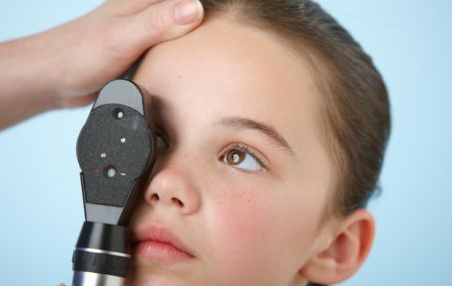
Amblyopia
is commonly known as lazy eye. This should not be confused with
squint. Amblyopia is poor vision in an eye that could not develop
normal sight during early childhood.
At
the age of eight years, the development of the part of the brain that
processes vision is almost complete. If the brain has not received
clear images from the weak eye, it starts neglecting this eye. The
eye is then said to be amblyopic or lazy as the vision does not
develop.
- Refractive errors such as Short Sightedness, Long Sightedness or Astigmatism.
- Large difference in spectacle powers between the two eyes.
- Strabismus or squint.
- Obstruction of vision by droopy eyelid, cataract or other diseases.
Management
Successful
treatment depends on how severe the Amplyopia is and the age of the
child when treatment begins. If the problem is detected early,
successful treatment is possible and treatment time is shorter, if it
is detected after the age of 8 years the success rate will be low.
..Spectacles
The
child should be encouraged to wear his or her spectacles as much as
possible throughout his waking hours if he or she is being treating
for Amblyopia.
..Patching
The
treatment consists of patching the GOOD EYE, so that the affected eye
is made to work and the child is encouraged to see with it. It
requires a tremendous amount of co-operation and understanding by the
parents.
..Pharmacological
treatment
Sometimes
we prescribe some medications to help the amblyopic eye see well.
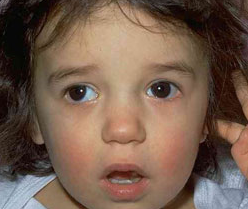
Squint
or crossed eye is a condition where both eyes do not move together.
One eye deviates either inwards, outwards, upwards or downwards while
the other eye remains straight. It may also be alternating between
the two eyes. Refractive errors are the most common causes of the
squint, the other being lazy eye, nerve or muscle weaknesses and
injury.
Management
 Treatment
of squint requires a combination of glasses, exercises and surgery.
Surgery may be needed in one eye or both eyes depending upon the
squint, essentially it is a combination of loosing or tightening of
eye muscles.
It
is important to correct squint as it can lead to deep Amblyopia and
psychological problems in children, loss of binocular vision, and
loss of depth perception. Many simple activities like threading a
needle, ability to understand the depth of staircase or liquids in a
glass and functioning on a microscope become difficult.
Normally
the tears are formed by the tear glands in the eyes and are drained
off through two holes in the corners of the eyelids called punctae
into the nose through a duct. The entire drainage system is called as
Nasolacrimal duct system. Sometimes there can be a block at any
level, at the punctum or in the ducts which may fail to open after
birth resulting in persistent watering or discharge from the eyes. If
left unattended this can lead to infection and painful swelling near
the bridge of the nose.
Management
..Massaging

..Probin
If
massaging fails a wire probe might need to be passed through the duct
forcing it to open. This is done under anesthesia or sedation in
small children.
..Lacrimal
Duct Surgery
If
the above methods fail to open the blocked ducts, surgery is
recommended in children above 1 year of age. The surgery is done
under general anesthesia.
Introduction
Cataract
can affect a child as young as a new born baby. Cataract in children
cause severe damage to the development of vision and needs to be
treated as an emergency.
There
are various causes of cataract in children like hereditary, genetic,
infectious, metabolic, eye injuries etc. It is not possible to
ascertain the cause in every child.

However,
sometimes investigations are needed to find the cause as they have a
big impact on child's life span and future quality of life.
What
is the treatment for Cataract?
- The treatment of cataract in a child is usually by surgery at the earliest.
- Cataract surgery in a child is totally different as compared to a cataract surgery in adults. There are many issues that are to be dealt with in a different manner in terms of examination as well as surgeries.

ROP
is a disease affecting the retina of premature infants. Very often
premature babies are kept in tents of hyperbaric oxygen until they
become fit to breath normally. The incidence of ROP is on a rise,
this is due to improved survival rates of very low birth weight and
extremely premature infants. The hyperbaric oxygen instigates the
growth of abnormal vessels from the retina. The key disease element
in ROP is growth of abnormal blood vessels with increased risk of
bleeding or developing retinal detachment.
- Which babies are at risk? Who should be screened?
The
criteria for screening babies are based on two critical factors –
the birth weight and the gestational age. In general infants with
birth weight less than 1700 grams and gestational age below 34 weeks
need screening.
- When should screening be done? How frequently should the child be examined?
As
a rule of thumb 1st
screening should be
over by Day 30 of baby's life. Very small babies (Weight < 1200
grams or < 24 weeks age) need to be screened within 2 weeks.
Depending on the stage of the disease immediate treatment or repeat
exams may be required.
- What is the treatment for ROP?
Treatment
is in the form of Retinal Lasers and surgery if Retinal detachment
develops.
Krishna Eye Centre provides best treatment for your child.....

For other information you can directly contact us!!!
Email : krishnaeyecenter@gmail.com


